← Back to The 2601 Salon

Section Six

Venues, Editors & How to Submit

Markets that welcome new poets, the editors who read them, and how to prepare and send your poems.

The Full Handbook

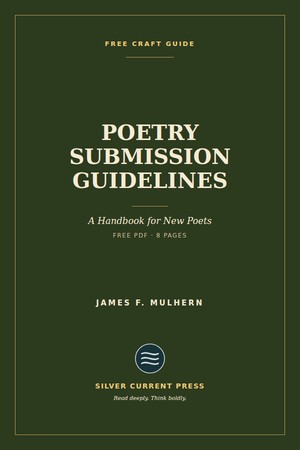
Poetry Submission Guidelines (PDF)

Everything on this page — and more — is gathered in a formatted, printable handbook. Keep it beside your notebook as you build your submission list.
Download the Handbook (PDF)
Free PDF · 8 pagesPoetry Submission GuidelinesA Handbook for New PoetsDownload PDF ↓

Selected literary markets

These journals are open to poets without long publication records. Their guidelines are clear, and they care more about the poems than about credits. The details come from each journal’s own guidelines in 2026.

FP

Editorial Collective

1  ·  Frontier Poetry

Looks for: Inventive language, strong feeling, and attention to form; open to anything from sonnets to experimental free verse.

Limits: Up to 5 poems in one document, no more than 10 pages.   Window: Year-round, in the free “New Voices” category.   Pay: $50 for each poem published.

Submit: frontierpoetry.com/submit

Note: Frontier welcomes poets without long publication histories. Put your strongest poem first.

R

Timothy Green

2  ·  Rattle

Looks for: Poems that move the reader, in free verse or traditional forms.

Limits: Up to 4 poems; any length.   Window: Year-round; always free.   Pay: $200 a poem and a one-year subscription for print; $100 a poem online.

Submit: rattle.submittable.com

Note: Rattle reads without names. Keep your name and contact details out of the file itself and enter them only in the Submittable form. Rattle also runs “Poets Respond,” a weekly feature for poems about the past week’s news.

AJ

Peter LaBerge

3  ·  The Adroit Journal

Looks for: Distinct contemporary voices, vivid images, and risk-taking language.

Limits: Up to 6 poems in one file; no line maximum.   Window: Two a year, recently February 15–April 1 and September 15–November 1.   Pay: $50 to each poetry contributor.

Submit: adroit.submittable.com

Note: Adroit was founded by a high school sophomore and still makes a point of supporting student and emerging writers, especially through its annual Adroit Prizes.

RM

Editorial Board

4  ·  Rust & Moth

Looks for: Strong images and short, concentrated poems.

Limits: Up to 3 poems in any style, once per window.   Window: Mar 1–20, Jun 1–20, Sep 1–20, Dec 1–20.   Pay: None; poems appear online, then in print and as a free ebook.

Submit: by email — guidelines at rustandmoth.com/submit

Note: Send the poems as a single PDF attachment, put the word “Submission” in the subject line, and paste a third-person bio of no more than fifty words into the body of the email. Rust & Moth answers within about six weeks and does not accept poems written or edited with generative AI.

T

Helen Vitoria

5  ·  Thrush Poetry Journal

Published: Lyrical, musical poems that used silence and space.

Limits: Up to 4 poems; strictly one page per poem.   Status: Closed permanently; the November 2024 issue was its last.

Archive: thrushpoetryjournal.com

Note: Thrush no longer takes submissions, but the archive is worth reading, and its lesson applies everywhere: read your poems aloud before you send them.

Quick market comparison table

MagazineMax PoemsMethodKey Preference
Frontier Poetry5 poemsSubmittableBold imagery, structural diversity
Rattle4 poemsSubmittable (blind)Emotional clarity, narrative drive
The Adroit Journal6 poemsSubmittableContemporary, high-energy language
Rust & Moth3 poemsEmail (.PDF)Visceral, object-oriented textures
Thrush Poetry Journal—Closed (2024)Highly musical, lyrical cadence

The mechanics of preparing your packet

Editors want to see the poem and nothing else. These steps work for almost every journal.

Step One — Typography & Layout
  • Use a clean, cross-platform serif such as Georgia or Garamond, 12-point.
  • Set line spacing to single or 1.15.
  • Begin each poem on its own page.
  • Leave out borders, colored backgrounds, and decorative fonts.
Step Two — Title Page & Anonymity
  • Check whether the journal requires a blind submission.
  • If not blind: place your legal name, pen name, email, and phone in the upper-right corner of the first page.
  • If blind: strip all identifying details from both the document text and its metadata.

The professional cover letter & bio

Editors read many letters a week. A brief, polite one is best. You can adapt this:

Dear Editors of [Journal Name], Please consider the attached poems, “[Title A],” “[Title B],” and “[Title C],” for publication in [Journal Name]. My work explores [one short phrase about your subjects or methods]. A short biography is below. Thank you for your time. Sincerely, [Your Name]

The third-person bio should be 30–50 words, concrete, and factual — current study, region, and any writing community. Avoid declarations of philosophy.

Jane Doe writes poems about memory and place. She lives in Philadelphia, Pennsylvania, where she belongs to a weekly writing group. Model bio, ~30 words, third person

Industry resources & databases

Free · Crowdsourced

The Submission Grinder

Search by genre, length, and pay; shows how long each journal usually takes to reply.

Visit →

Modern · Accessible

Chill Subs

A friendly, easy-to-search site that lists reading fees, response times, and what each journal publishes.

Visit →

Institutional

Poets & Writers Database

The long-standing directory of print and online journals. Use it to confirm that a journal is real and how long it has been publishing.

Visit →

No-Fee Advocacy

Trish Hopkinson’s Blog

Up-to-date lists of good journals that charge no reading fee.

Visit →

Keeping track of your submissions

Simultaneous submissions. Most journals permit sending the same packet to several magazines at once. The obligation: if a poem is accepted by one, immediately notify and withdraw it everywhere else it is pending. On Submittable, use the Messages/Notes tab; withdraw the whole submission only if all its poems are taken.

Treat submission as an impersonal administrative ritual that protects your creative fire. When a rejection arrives, do not let it linger. Open your tracking ledger, find the next target, and send the work back out the same day.James’s perspective on rejection

Rejection is not a verdict on your worth. An editor may admire your craft but have already filled the issue with poems on your subject. Every poet you admire has a long list of rejections. Record each one, send the poem to the next journal, and keep writing.

Your words are valuable, your perspective is necessary, and persistence is the key that finally unlocks editorial doors. Keep writing, keep revising, keep submitting.

Market details compiled in the Silver Current Press Poetry Submission Guidelines. Verify all guidelines on each journal’s own site before submitting, as windows and terms change. Databases: The Submission Grinder, Chill Subs, Poets & Writers, Trish Hopkinson.

See James Mulhern’s full body of work — fiction, courses, and publishing — in The Gathering Room →