Writing a poem and sending it out are two different kinds of work. The first is private. The second is mostly clerical: reading guidelines, formatting files, keeping records. Neither is beneath a poet.
For those seeking their first print or digital credits, the publishing world can be hard to read. This guide tries to make it clearer: how editors read, which poets reward study, what a good poem does on the page, and where a new writer can reasonably send work.
Read it in any order, and use the index below to go straight to your question. Keep a notebook or a spreadsheet open beside you. Mark deadlines, note the poets who make you jealous, and come back to the guide as you need it.
There are no shortcuts and no secret handshakes. There is only the poem, the reading that sharpens it, and the persistence that finally sends it out.
— James F. Mulhern, Silver Current Press
James F. Mulhern
Philadelphia ◆ Silver Current Press
A Companion to Keep
The Submission Handbook, for Print or Keeping
The complete Poetry Submission Guidelines — an eight-page handbook with five journals to know, how to prepare a submission, a model cover letter, where to find more journals, and a short glossary — is available as a PDF to print or keep on your desk.
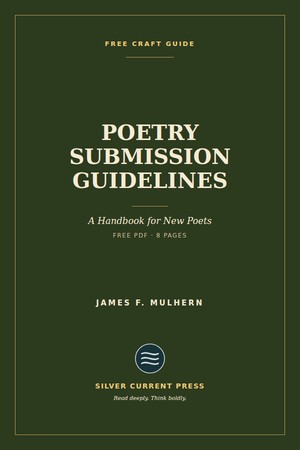 Free PDF · 8 pagesPoetry Submission GuidelinesA Handbook for New PoetsDownload PDF ↓
